













Jessica Lass
Senior Communications Advisor
After Hurricane Helene in 2024, one lesson became impossible to ignore in Boone, North Carolina: clean energy is resilience.
As floodwaters knocked out critical communications and damaged utility equipment, George Santucci, Sustainability and Special Projects Manager for the Town of Boone, saw clearly what local solar and battery storage could mean for a mountain town in crisis; not just lower emissions, but keeping people connected when it mattered most.
“While small, the impact would be great,” he said, describing how backup solar and batteries could help keep communications online when fuel-powered generators become harder to refuel and maintain in mountainous terrain.
That urgency to be prepared for the next Helene is now shaping Boone’s new chapter, from landfill solar to battery storage and emergency backup systems.
A clean energy mix built for the mountains
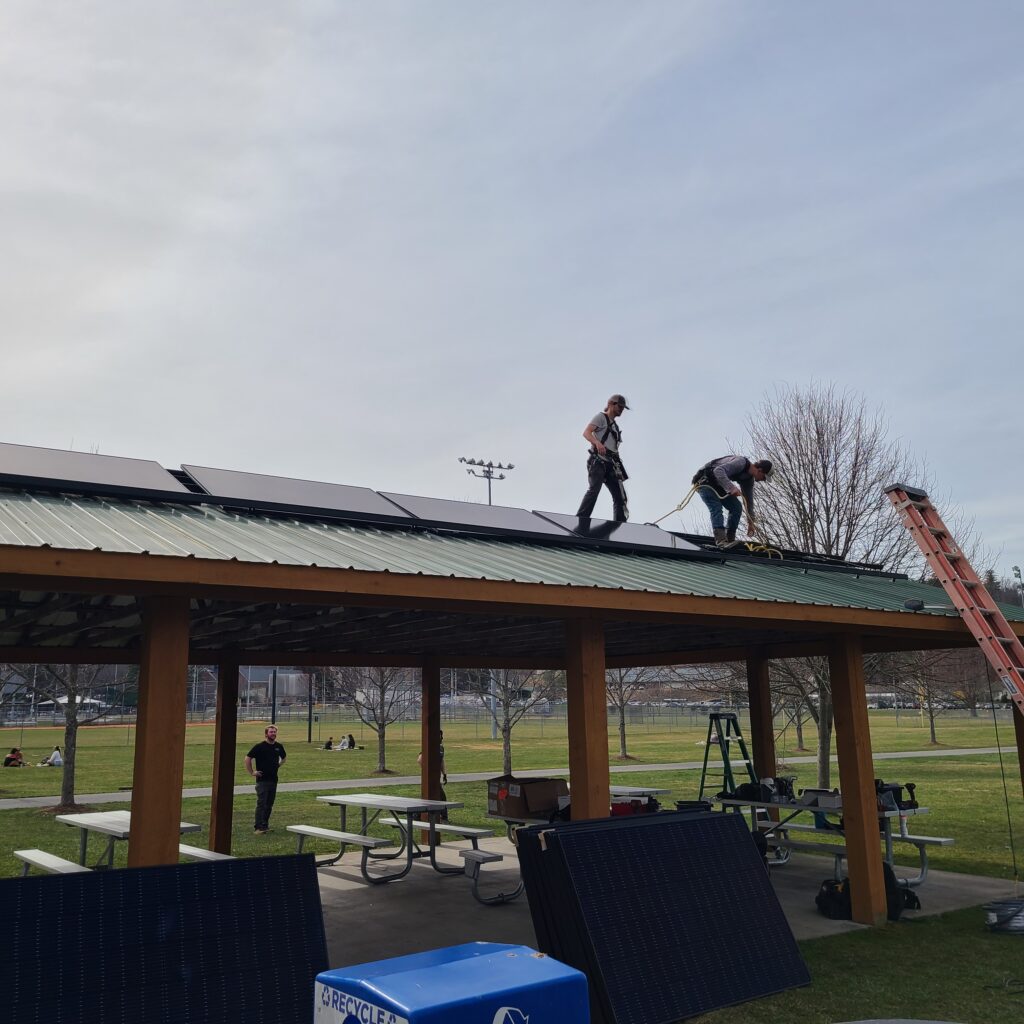
With steep terrain, lots of tree cover, and very little open land, Boone can’t rely on large solar fields within town limits. Rooftop solar helps, but it won’t meet the whole community’s needs.
Instead, Boone partnered closely with its local utilities to build a renewable energy mix that works for its geography, including hydropower and off-site solar.
Unlike many North Carolina communities, Boone is not served by Duke Energy. Instead, it works with two smaller providers, New River Light & Power and Blue Ridge Energy, which gives town leaders a level of direct access and collaboration that is unusual for a municipality.
“Town leaders can sit down directly with utility decision-makers and problem-solve together,” says Santucci. “That local collaboration has been a game changer for our energy mix.”
Additionally, Blue Ridge Energy built a 10-megawatt (MW) solar array in Caldwell County, while New River Light & Power supplied hydropower through its green tariff program. Boone has also made it easier for residents to adopt rooftop solar by waiving permit fees for residential installations and EV chargers and speeding up permitting timelines.
How an old landfill became Boone’s next big idea
Now Boone is taking its next big step: solar on a capped landfill just outside town. Spread across nearly 15 acres of open capped land just beyond Boone’s town boundary, the former landfill is one of the only large, treeless spaces in the area; a rare patch of usable ground in a mountain town where steep slopes and forests dominate the landscape. Because the site can never be developed for homes or businesses, it offers an ideal place to turn yesterday’s waste into tomorrow’s clean energy.
When complete, the project will generate at least 2 MW of local solar to help power the community. George compares the project to installing roughly 200 rooftop solar systems at once. It’s the kind of scale that’s hard to achieve where land is scarce and expensive.
“A significant portion of town residents believe that rooftop solar is the only way to go,” says Santucci. “Renewable energy is renewable energy. I don’t care where it comes from. Rooftop solar is an important tool, but not enough on its own.”
Why progress beats perfection
Boone’s example is also a story about persistence. The idea of putting solar on the landfill first surfaced more than a decade ago, and only now, thanks to better technology, financing, and local partnerships, is it becoming real. That long runway is part of the lesson too: sometimes clean energy projects take time, but the right project is worth sticking with.
“Progress is progress,” says Santucci. “It’s never fast enough, but you have to keep moving.”

The resilience lesson Boone won’t forget
2024’s Hurricane Helene gave Boone another reason to double down on local clean energy. The storm knocked out critical infrastructure and communications systems, showing how valuable local solar and batteries could be during emergencies. While Boone’s small solar installations held up physically, flooding damaged other equipment needed to move power onto the grid.
That experience pushed battery storage and backup solar even higher on the town’s priority list, especially for communications hubs, emergency response, and critical community services. For George, resilience is not just reducing emissions, but helping the town stay connected and recover faster when disaster hits.
In 2022, Boone became the first town in North Carolina to power its municipal operations with 100% renewable energy, proving that towns do not need to wait for ideal conditions, massive budgets, or flawless consensus to move forward. Other North Carolina towns have looked to Boone for guidance on how to establish sustainability programs and pursue local clean energy solutions.
“I’m most proud of being the first town in North Carolina with all renewable energy,” says Santucci. “We have to eliminate fossil fuels. We have to stop burning fossil fuels at any cost. We also need big goals, but they need to have realistic pathways that give people hope and deliver measurable progress.”
What other small towns can learn from Boone
If there is a single theme that runs through Boone’s story, it is that climate action requires pragmatism as much as ambition. Santucci is direct about the limitations of idealized thinking, especially in a place with physical, political, and financial constraints.
As Boone continues to build on that foundation, its example is sending an important message to other communities: you do not have to be big to lead, and you do not have to be perfect to make real progress. Just get started where you are and with what you have.


