











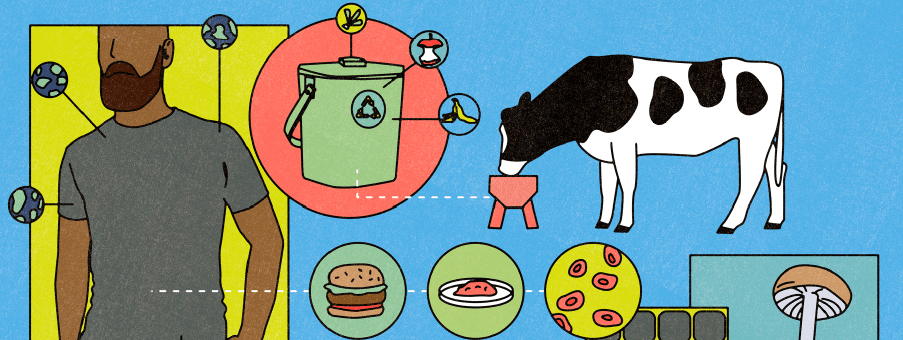
Have you noticed how new clean tech innovations keep popping up lately given all of the R&D funding out there? Lab-grown meat, algae-based bags, compostable bottles, hydrogen batteries—it’s hard to keep track! With many high-impact climate solutions ready for their close up—which ones are worth following? Here’s our take on five, cutting-edge clean energy innovations worth keeping your eyes on.
Climate Solution #1: Mushrooms, mushrooms, mushrooms – what can’t they do?
Mushrooms hold massive untapped potential as a climate change solution, particularly as a replacement for meat—a food source well-known for its high carbon footprint. And we’re not just talking about swapping your burger patty for a roasted shiitake mushroom—we’re talking five-star restaurant worthy, nutrient-dense Fy.
Fy is a mushroom created from a microscopic fungus discovered at Yellowstone Hot Springs in Montana. It’s packed with protein and all nine essential amino acids, and highly versatile. It can be manipulated into a range of meat-free, dairy-free, and gluten-free foods, and even dried into flour. The protein is grown quickly in cafeteria-size trays through fermentation-based technology—like a kick-ass sourdough starter. In less than four days, a tray of microbes develops into the protein equivalent of 20 to 25 chickens.
-

Nature’s Fynd, using Fy in products ranging from breakfast patties to cream cheese
In addition to serving as a meat alternative, mushrooms are being used as a sustainable packaging alternative, too. As brands look to use more environmentally friendly alternatives to plastic packaging, mushrooms are playing a starring role. Mushroom packaging material is often composed of a combination of fungus roots called Mycelium and agricultural waste such as hemp and corn husks. It’s a highly durable material, so there’s no need for extra bubble wrap or styrofoam—at the same time, when it’s served its purpose, it’s compostable and doesn’t contribute to landfill waste.
Climate Solution #2: Algae – From food to fashion?
While we’re not sold on turning to algae for fuel, there is promise this plant has potential when it comes to solving some of the fashion industry’s environmental challenges.
Currently, cheap synthetic fabrics like polyester are made from fossil fuels, and the most common dyes used to make certain textiles shiny are derived from crude oil. Algae, on the other hand, acts as a carbon sink–—pulling emissions out of the air. It’s also fast and cheap: it requires 80% less water than cotton and grows 8x as fast. Startups are now developing algae-based dyes and yarn. Although in its early stages and a bit too pricey for the mass market (like this $120/t-shirt from Vollebak), you might be wearing an algae-based ‘fit sooner than you think.
Climate Solution #3: AI is in the air
Artificial intelligence (AI) and machine learning are drastically changing industries across the globe, including clean energy. If you imagine a future powered by clean energy and distributed resources—with renewables and the grid coexisting—AI is going to be an integral part of managing energy demand.
AI-based software can be used to make sure that grid operators are making the best economic and environmental decisions. Peak Power is doing just that. It applies AI knowledge to optimize batteries, EVs, and grid-interactive buildings. This platform makes sense of all types of data inputs: solar panel output, energy demand, historical weather data, energy use trends, peak rates, etc. and assesses when the best times would be for you to buy or sell energy on the grid. Mobilyze is another interesting startup that leverages the power of AI to promote the widespread use of electric vehicles as well as increasing access to EV charging where it is needed most.
As we collect more data and knowledge from current power systems, we can identify and predict patterns to help us run more efficient and resilient clean energy grids.
Climate Solution #4: Lab-grown meats
We’ve heard about lowering the carbon footprint of your meal by eating plant-based, but what if animal-based proteins were less resource-intensive? That’s where lab-grown meat comes in.
Although once an element of science fiction, this protein is nearly ready for menu primetime. Cultivated meat is derived from a small sample of cells collected from livestock, which is then fed nutrients, grown in enormous steel vessels called bioreactors, and processed into something that looks and tastes like a real cut of meat.
Upside Foods is one of several startups seeking FDA approval to start bringing it’s slaughterless-meats to high-end restaurants and supermarkets. They grow meat, poultry and seafood directly from animal cells. In addition to eliminating inhumane animal treatment, cultivated meat production—at scale—will use less water and land than conventionally-produced meat. Upside was the first-ever company to successfully produce multiple varieties of lab-grown meat, receiving several awards for their innovation.
-

A dinner plate featuring Upside’s lab-grown chicken.
While many people get squeamish at the idea of cultivated meat, pea-protein “chicken” nuggets, enriched foods, and GMOs, are all going to be necessary components of the recipe to avoid the worst impacts of climate change. We are going to need to embrace the role technology can pay in helping feed a rapidly growing population amidst a more unpredictable, unsustainable climate.
Climate Solution #5: Don’t scrap your scraps—compost instead
Composting isn’t a new, cutting-edge technology, but it when done at scale, it has massive emissions reduction potential. Wasted food accounts for about 8 percent of global greenhouse gas emissions, and more than a third of all food—$408 billion worth—grown for human consumption in the U.S. never makes it to someone’s stomach.
One of the biggest contributors to wasted food happens at home. So what can you do about it? Compost!
Composting organic waste rather than sending it to the landfill can reduce more than 50% of carbon dioxide-equivalent greenhouse gas emissions. Beyond just reducing emissions, composting also acts as a carbon sink: by offering direct nutrients to plants to enhance their productivity and ability to store carbon in soils. Plus, it enhances soils and can help reduce demand for nitrogen fertilizers.
A newly launched startup called Mill Industries wants to make it easier for everyone to compost at home. Mill will send members a high-tech bin to send leftovers to instead of in the trashcan. The bin turns those leftovers into food grounds which get mailed back to Mill and used to make chicken feed. Going through this process can prevent a half-ton of greenhouse gas emissions per household a year.
Many cities and localities are already stepping up by advancing organics recycling and compost utilization, such as through innovative compost pilot programs and legislation that requires large food waste generators like colleges to both separate and recycle food waste.
Whatever you choose to try out from this list, keep in mind that more climate change solutions are always coming – that’s the benefit of living during a time when low-zero-carbon emission solutions are increasingly abundant. Just try what sounds interesting to you – you might be surprised by the results.